Data Anonymization

ANONYMIZE
SENSITIVE DATA.
PRESERVE ANALYTIC POWER.
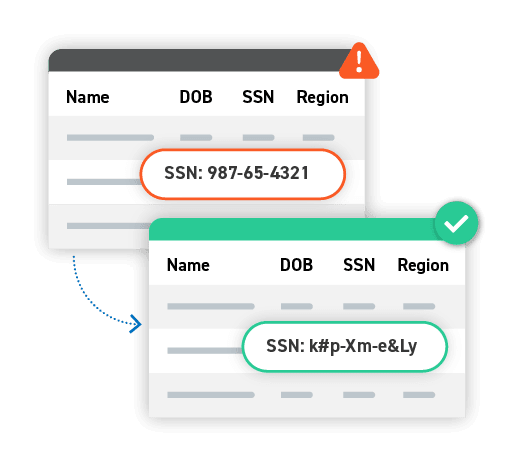
Protegrity data anonymization helps teams transform sensitive data so it can be used for AI, analytics, model training, testing, and secure sharing with reduced identity exposure. By applying privacy-preserving techniques at the data level, organizations can protect personal information while retaining useful patterns for approved analysis.

WHAT YOU NEED
TO KNOW ABOUT ANONYMIZATION

What It Is

Anonymization permanently removes or generalizes identifiers so individuals cannot be re-identified. Protegrity models use industry-proven patterns and techniques to reduce residual risk while maintaining data utility.

When to Use It

Ideal for preparing sensitive data for AI or ML model training, analytics, or secure data sharing, and when regulatory requirements demand irreversible protection — particularly in healthcare, finance, and other highly regulated industries where personal identifiers must never resurface.

Why It Matters

Anonymization unlocks the full analytics value of sensitive datasets — without compromising compliance with industry mandates for PII, PCI, and PHI or regional requirements like GDPR Recital 26, HIPAA Safe Harbor, and CCPA. Teams can harness this valuable data to accelerate AI development, generate insights, and collaborate with partners while safeguarding personal information.

The Protegrity Advantage

Why Our Anonymization IS Different

Protegrity brings anonymization into a broader data protection platform, so privacy-preserving data use can be managed alongside policy, governance, discovery, and other protection methods.
01
Policy-Aligned Privacy Protection
Apply anonymization in ways that align to approved data use, governance requirements, and privacy objectives.
02
System Analytics-Ready Data Utility
Preserve useful statistical patterns where appropriate so teams can continue analysis, model development, and reporting without relying on raw sensitive records.
03
Enterprise Data Protection Context
Use anonymization alongside tokenization, masking, encryption, pseudonymization, and synthetic data to match the right protection method to each workflow.
04
Support for AI and Advanced Analytics
Prepare data for AI training, testing, model validation, and analytics workflows while reducing exposure of personal identifiers.
05
Secure Data Sharing
Create privacy-preserving datasets for partners, vendors, research teams, or cross-functional collaboration without broadly exposing sensitive source data.
06
Centralized Governance Foundation
Support consistent policy control and operational governance across privacy-preserving data workflows.

    How Anonymization works

    Data anonymization starts by identifying sensitive fields and determining how the data needs to be used. Protegrity can then help transform identifying values while preserving the structure, relationships, or statistical characteristics needed for approved analytics and AI workflows.
    Identify Sensitive Data
    Locate personal identifiers and sensitive attributes such as PII, PHI, PCI data, account information, demographic attributes, or other regulated data elements.
    Select the Right Transformation
    Apply privacy-preserving techniques such as removal, generalization, suppression, aggregation, perturbation, or other anonymization methods based on the use case.
    Preserve Useful Patterns
    Maintain the analytical characteristics teams need for reporting, model development, testing, or trend analysis where appropriate.
    Govern Data Use
    Align anonymized data workflows with centralized policy, access controls, and data protection requirements.
    Enable Approved Workflows
    Use anonymized datasets for AI, analytics, testing, sharing, research, and long-term analysis without exposing raw sensitive identifiers.

      When Should You Use Anonymization?

      Data anonymization can accelerate decision-making across countless business scenarios. A few key examples include: 
      01
      AI/ML Model Training
      Prepare sensitive datasets for model training, fine-tuning, testing, or validation while reducing exposure of personal identifiers.
      02
      Analytics on
      Sensitive Data
      Support business intelligence, trend analysis, segmentation, and forecasting with privacy-preserving datasets.
      03
      Data Sharing & Collaboration
      Share useful datasets with internal teams, external partners, vendors, or research groups while limiting exposure of identifiable personal data.
      04
      Regulatory Compliance
      Support privacy-preserving data use in industries such as healthcare, financial services, retail, travel, and insurance where sensitive data requires stronger controls.
      05
      Data Localization
      De-identify at the source to move data across regions while meeting residency and transfer rules.

        Why Use Anonymization?

        Anonymization delivers permanent privacy protection that satisfies the strictest regulatory requirements while preserving the full analytical value of your data.

        Media block image

        Reduce Identity Exposure

        Transform sensitive data so personal identifiers are removed, generalized, or altered before the data is used in broader workflows.

        Media block image

        Preserve Analytical Value

        Keep useful patterns and relationships available for analytics, AI, testing, and reporting where the use case does not require raw identifiers.

        Media block image

        Support Safer AI Development

        Prepare privacy-preserving datasets for model training, validation, testing, and experimentation.

        Media block image

        Enable Secure Data Sharing

        Share anonymized datasets with partners, vendors, researchers, or internal teams with less reliance on raw sensitive data.

        Media block image

        Lower Breach and Compliance Exposure

        Reduce the amount of directly identifiable information available in downstream environments, which can help lower operational, compliance, and breach-response risk.

        Complete Your AI Security Strategy

        Beyond Anonymization: Comprehensive AI Protection

        Anonymization is just one part of Protegrity’s AI security platform. Strengthen your AI ecosystem with Protegrity’s full portfolio of advanced data protection capabilities — from tokenization and format-preserving encryption to dynamic data masking and synthetic data generation.

        Text To Analytics

        Ask questions of structured data in natural language, with embedded protection ensuring results stay secure.
        Learn more

        Semantic Guardrails

        Enforce dynamic, context-aware controls that block unsafe queries and prevent data leakage in real time.
        Learn more

        Synthetic Data Generation

        Generate statistically accurate, bias-aware datasets that preserve utility without exposing sensitive information.
        Learn More

        Find & Protect

        Automatically detect and protect sensitive data across ingest, training, and outputs.
        Learn More
        The Protegrity Data Protection Platform

        Explore Data-Centric
        Data Protection

        Anonymization is part of the Protegrity Platform — delivering centralized policy control, modular capabilities, and data-centric protection across every stage of the AI pipeline.

        Discovery

        Identify sensitive data (PII, PHI, PCI, IP) across structured and unstructured sources using ML and rule-based classification.

        Learn More

        Governance

        Define and manage access and protection policies based on role, region, or data type—centrally enforced and audited across systems.

        Learn More

        Protection

        Apply field-level protection methods—like tokenization, encryption, or masking—through enforcement points such as native integrations, proxies, or SDKs.

        Learn More

        Privacy

        Support analytics and AI by removing or transforming identifiers using anonymization, pseudonymization, or synthetic data generation—balancing privacy with utility.

        Learn More