Protegrity & Bodo.ai
Live Demo
View DemoProtegrity Native
The integration is native to Protegrity and offers a more seamless experience when applying this platform.
Integration type
- Analytics
Partner
Yes
Supported platforms
- AWS
- Azure
- GCP
Use cases
- Agentic Pipeline Protection & Runtime Enforcement
- Cloud Migration & SaaS Integration
- Internal Data Democratization & External Data Sharing With Partners/Vendors
- Privacy-enhanced Training Data for AI/ML Models
- Prompt Input Filtering & Output Curation for GenAI Systems
- Regulatory Compliance & Data Sovereignty
overview
The Protegrity–Bodo Secure Text-to-Analytics solution lets organizations unlock the value of sensitive data with natural language queries and high-performance analytics while ensuring end-to-end security and compliance.
- Protegrity guarantees that sensitive data fields (e.g., PII, PHI, financial data) are always protected.
- Bodo delivers HPC-scale performance for analytics, reducing processing times from hours to minutes.
Together, they enable enterprises to run analytics and AI use cases that were previously blocked by compliance concerns or performance limits. This integration will also democratize data access across the organization, ensuring that even users without permission to view sensitive data in the clear can still derive analytical value. By asking questions in plain English, users receive complex SQL and Python translations behind the scenes, which return the analytical insights they need — all while the underlying data remains protected.
Key Integration Feature
The integration between Protegrity and Bodo establishes a critical defense for Generative AI by enabling dynamic, metadata-driven protection and unprotection of sensitive data assets. By embedding Protegrity’s granular security policies directly into Bodo’s compute engine, the solution automatically secures data within AI-assisted SQL workflows based on user authorization and context. Crucially, this seamless enforcement occurs without sacrificing performance, allowing enterprises to leverage the full velocity of Bodo’s parallel processing while maintaining strict compliance and privacy standards in their GenAI pipelines.
Features & Capabilities
01
Secure Text-to-Analytics: Natural language queries on structured data with complete privacy.
Why It Matters
Natural language queries on structured data with complete privacy, enabling business users to interact with data safely while bypassing risks of data leakage.
How it Works
Protegrity ensures queries and responses remain fully compliant, even when sensitive data is processed.
02
End-to-End Data Protection: From ingestion to analytics results, all data is safeguarded.
Why It Matters
From ingestion to analytics results, all data is safeguarded, guaranteeing compliance with regulations like GDPR, HIPAA, and PCI-DSS.
How it Works
Field-level encryption ensures sensitive identifiers are protected at every stage.
03
High-Performance Parallel Analytics: Bodo’s distributed engine processes petabytes of data with Python simplicity.
Why It Matters
Bodo’s distributed engine processes petabytes of data with Python simplicity, delivering lightning-fast performance for AI/ML workloads.
How it Works
Bodo customers achieve up to 10x faster data analytics vs. legacy solutions.
04
Flexible Deployment: Works across multi-cloud and hybrid environments.
Why It Matters
Works across multi-cloud and hybrid environments, reducing vendor lock-in and supporting enterprise-scale architectures.
How it Works
Seamless integration into existing data lakes and pipelines.
05
Developer-Friendly Experience: Simple Python APIs with enterprise-grade security.
Why It Matters
Simple Python APIs with enterprise-grade security, making advanced analytics accessible without deep security expertise.
How it Works
Data scientists can focus on models, while security is automated.
Architecture &
Sample Data Flow
The data journey
Visualizing the data journey
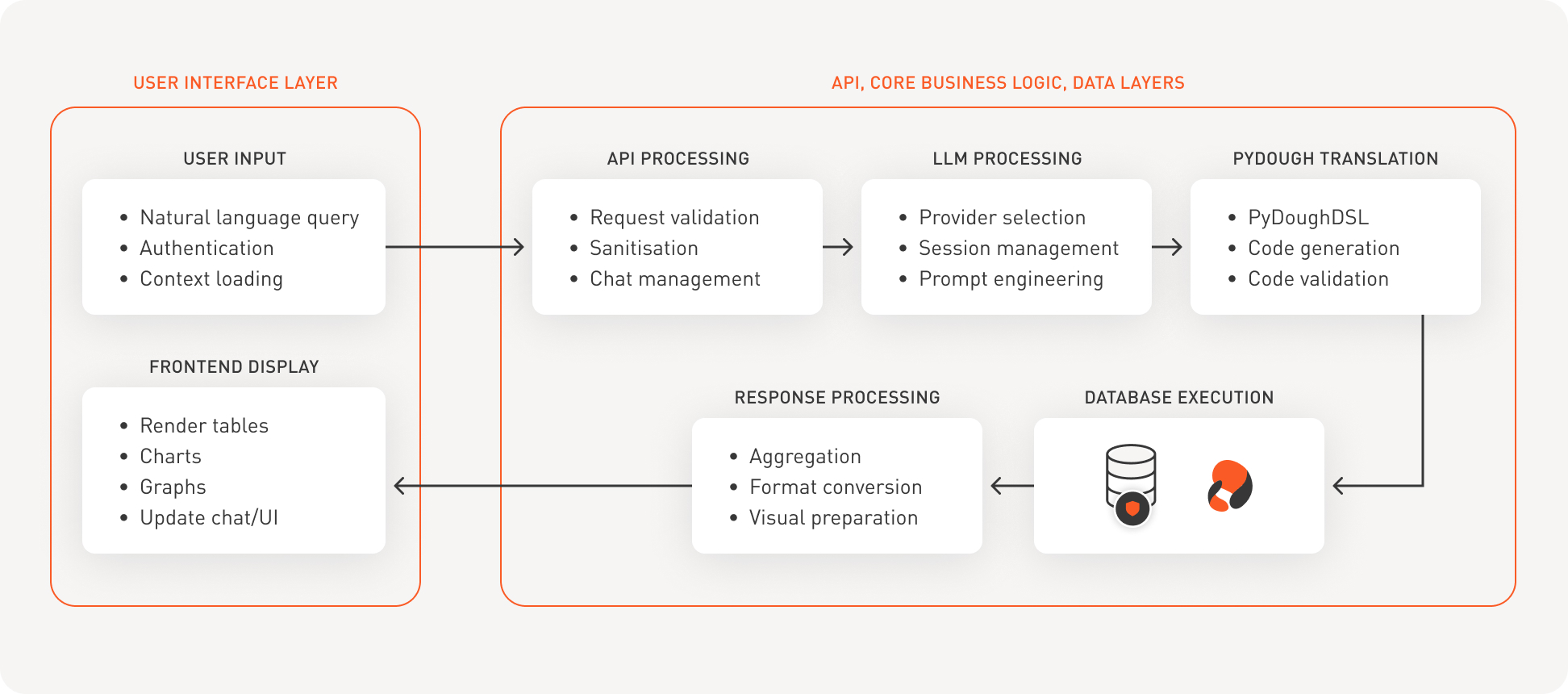
The data journey explained
-
01
User Input (UI Layer)
- The user submits a natural-language query.
- Authentication occurs and the user context is loaded (role, permissions, session).
- Output: an authenticated request moves to the API layer.
-
02
API Processing
- Request validation checks structure and permissions.
- Sanitization removes/neutralizes unsafe content.
- Chat management maintains conversation state.
- Output: a clean, authorised prompt for model orchestration.
-
03
LLM Processing
- Provider selection chooses the model/service.
- Session management tracks tokens and state.
- Prompt engineering structures the instruction the model receives.
- Output: an intent/plan that can be translated to executable data work.
-
04
PyDough Translation
- Build a plan in PyDough DSL.
- Code generation creates executable queries/operations.
- Code validation ensures safety and correctness before execution.
- Output: vetted code ready to run against the data platform.
-
05
Database Execution
- The generated code runs against the client’s database/data platform.
- Data is stored protected by Protegrity at rest
- During reads/writes, Protegrity policies are enforced via its APIs/protectors
-
06
Response Processing
- Aggregation combines results.
- Format conversion prepares tabular/graph-friendly outputs.
- Visual preparation organizes content for display.
-
07
Frontend Display (UI Layer)
- The UI renders tables, charts, and graphs, and updates the chat/UI with the results.
- Control returns to the user for further questions/refinement.
Use Cases
Examples where Bodo has helped achieve a business goal.
Finance
Challenge
Financial institutions must process massive volumes of sensitive transactions in real time, while maintaining strict controls over PCI, PII, and confidential data. Migrating legacy platforms to the cloud introduces additional risks around data sovereignty and compliance.
Solution
Bodo executes distributed fraud analytics at scale, while Protegrity enforces tokenization and masking across hybrid and multi-cloud environments. Vaultless Tokenization and centralized policy management ensure consistent protection, even as workloads shift between on-premises and cloud.
Result
Banks and financial services firms reduce risk and accelerate cloud adoption. They can migrate previously blocked workloads, standardize data protection policies, and provide secure, real-time data access for authorized teams, supporting PCI and PII use cases and simplifying audits.
Healthcare
Challenge
Healthcare organizations face stringent compliance requirements when analyzing sensitive patient data stored in Electronic Health Records (EHRs). Balancing privacy, regulatory mandates (like HIPAA), and the need for rapid clinical insights is a persistent struggle.
Solution
The Protegrity–Bodo integration enables protected-at-rest EHR data to be analyzed at scale. Protegrity’s field-level security policies govern every view and query, ensuring only authorized access while Bodo’s parallel engine delivers high-speed analytics.
Result
Healthcare providers gain faster, actionable insights for patient care and operational efficiency, all without exposing patient identities or breaching compliance. This unlocks new possibilities for population health analytics, predictive modeling, and research, while maintaining strict privacy controls.
Retail
Challenge
Retailers need to unify customer and transaction data from diverse sources (POS, ERP, e-commerce) for analytics, personalization, and inventory management. Ensuring only authorized views and minimizing exposure of sensitive information is critical.
Solution
Bodo’s engine scales complex joins and aggregations across large datasets, while Protegrity ensures that outputs are restricted to authorized views. Field-level protection and policy enforcement minimize the risk of data leakage.
Result
Retail organizations make better, data-driven decisions with minimized exposure of sensitive customer and transaction data. This supports advanced analytics for marketing, supply chain optimization, and fraud prevention, all while maintaining compliance.
Manufacturing
Challenge
Manufacturers generate high-volume IoT and telemetry data, often containing sensitive operational parameters. Real-time analytics are needed for predictive maintenance and process optimization, but data privacy and security must be maintained.
Solution
The integration supports both streaming and batch analytics, with Protegrity policies enforced on-the-fly. Sensitive fields are protected throughout the data lifecycle, from ingestion to analysis.
Result
Manufacturers gain predictive insights to improve uptime and efficiency, while sensitive operational data remains protected. This enables secure sharing of insights across teams and partners, supporting innovation without compromising security.
DEPLOYMENT
Customer-controlled data:
Bodo compute:
Policy integration:
Governance:
RESOURCES
Quick reads and docs to help your team deploy Protegrity with Bodo—natural-language SQL, HPC-scale analytics, and field-level protection without slowing performance.
Protegrity Documentation
Product docs, APIs, protectors, deployment guides, and policy examples for discovery, tokenization/masking, and everything you need to implement Protegrity.
READ MOREBodo/PyDough Documentation
Developer guides for Bodo’s distributed compute and PyDough DSL—install, scale-out patterns, tuning, and best practices for high-performance analytics.
READ MOREFrequently
Asked Questions
All data remains within the customer’s own platforms—whether on-premises, private cloud, or public cloud environments. Protegrity’s protection mechanisms are applied directly to data at rest, and Bodo reads and processes the data where it resides, ensuring no unnecessary movement or duplication of sensitive information.
During analytics operations, Bodo transparently invokes Protegrity APIs and protectors. This means that security policies are enforced in real time, and data is shown either in the clear, masked, or tokenized according to user permissions and context. Every read, write, or transformation operation is subject to the appropriate policy, ensuring compliance and privacy throughout the analytics workflow.
Security policies and key material are managed centrally within Protegrity. Policies are not embedded in jobs or notebooks, which allows for dynamic updates and consistent enforcement across all environments. Administrators can update policies and rotate keys from a single interface, ensuring that changes are immediately reflected in all data operations.
Protegrity’s governance framework records all actions related to data access, policy enforcement, and protector operations. Audit logs capture access context, policy decisions, and protector actions, enabling comprehensive compliance reporting and forensic analysis. This supports regulatory requirements such as GDPR, HIPAA, and PCI-DSS, and provides detailed visibility into who accessed what data, when, and under what policy conditions.
No. The solution leverages the customer’s existing infrastructure and applies security controls directly to data where it resides. There is no need to migrate or duplicate data, which simplifies deployment and reduces risk.
Yes. Both Protegrity and Bodo support flexible deployment models, including on-premises, private cloud, public cloud, and hybrid/multi-cloud scenarios. Security policies and analytics workflows are enforced consistently across all supported environments.
The integration supports both batch and real-time analytics, including AI/ML workloads, fraud detection, predictive modeling, and business intelligence. Bodo’s distributed engine enables high-performance processing of large and complex datasets.
See the
Protegrity
platform
in action
Accelerate data access and turn data security into a competitive advantage with Protegrity’s uniquely data-centric approach to data protection.
Get an online or custom live demo.