Future Data Theft and How We’ll Fight Back
You wake up in the year 2047, where everything is connected to a network. You stretch your arms as your AI coffee maker prepares beans harvested on the moon. With five rapid blinks, you deactivate “do not disturb” on your brain-implanted HUD, and suddenly, you receive a barrage of bank notifications alerting you to suspicious activity. How did they get your passwords? Biometric data? Was it your smart toilet? Your robotic housekeeper? What about your brain-implanted HUD? Come to think of it, your PIN did appear frequently in your dreams last night. Welcome to the future, where thieves syphon your data straight from your cyber veins.
A VERY BRIEF HISTORY
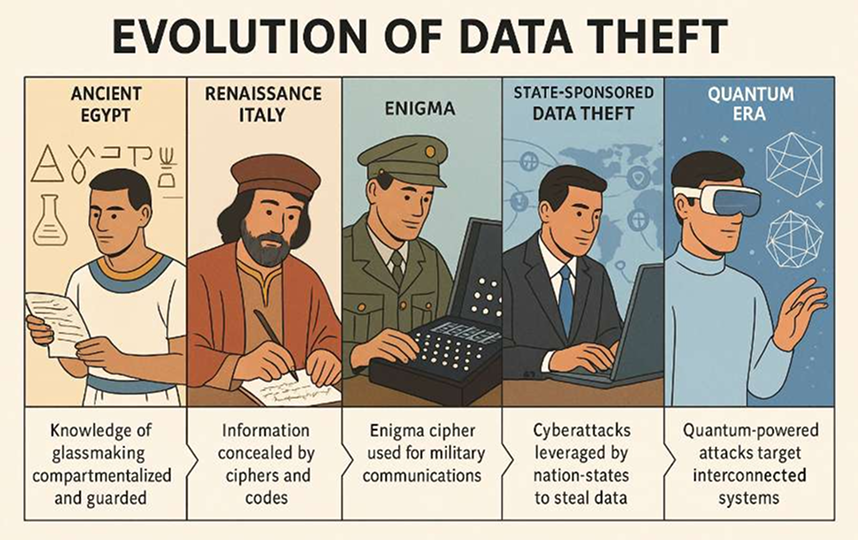
People have been stealing data for a very long time. Actually, we may never know it, but there’s probably a story beyond the stars regarding one deity stealing another’s blueprints for the Big Bang. Nasty dispute. Ongoing. One of the earliest recorded data theft attempts occurred in Ancient Egypt (~1500 BCE), when neighboring civilizations sought to acquire knowledge of glassmaking, a symbol of power and prestige with high trade value. To protect this data, the Egyptians moved all glass production into the royal precincts, guarded raw materials, compartmentalized the process, and only passed down skills orally and through hands-on practice. They never wrote anything down about glassmaking. That’s how they protected their valuable data, by building security around it.
But we all know the luxury of jotting something down so we don’t forget it. That’s why many centuries later, in Renaissance Italy, as trade, science, and art flourished at a rapid pace, valuable information was recorded on manuscripts. Competitors would pay handsomely to steal blueprints, financial ledgers, and formulas. How did they protect their data? Leonardo da Vinci often wrote in mirror script (writing backward) and used personal shorthand. Many alchemists and scientists used symbolic language or code to hide chemical formulas and would omit important steps and purposely introduce errors (beyond theft protection, it helped with accusations of heresy!).
Renaissance Italy was a great example of people protecting data by using ciphers and codes. Like many things created and practiced in Renaissance Italy, data protection gained widespread popularity over the ages and became an important pillar of everyday life, even making its way into this very moment, right now, as you read this blog online.
CODE & CIPHER
As data became more valuable and harder to physically protect, people turned to encrypting their data with ciphers to hide it in plain sight. A cipher takes readable text and makes it unreadable by using a specific algorithm or rule. They became popular because it was easier than locking up data and guarding it. In 50 BCE, Julius Caesar started shifting letters in the alphabet by a fixed amount when writing military correspondence. George Washington led a spy ring during the American Revolution, where members would communicate British troop movements using codebooks, invisible ink, and ciphers. Probably one of the most famous ciphers was Enigma, an electromechanical cipher that the Nazis used for military communication, which we eventually cracked.
But then data got all cool and went digital in the 1970s. It went from cloak-and-dagger to click-and-drag. This benefited financial institutions, but it also created a new threat of digital bank fraud and pushed the U.S. to adopt the Data Encryption Standard (DES) to protect financial data. Two decades later, Public-Key Cryptology, systems that encrypt and decrypt by using two different keys, became the standard. But now, in the 2020s, ciphers are being tested like never before.
IT’S COMPLICATED
Remember when our biggest threat was an email from a Nigerian Prince with bad grammar? Those were the days. Now, the art of social engineering is deep fakes of Liam Neeson courting your mother for her 401(k) funds. Or complex phishing and/or honeypot scams, all starting from a text message confirming your attendance to “the party.” Then there are the technical attacks where digital thieves hijack payment gateways, spoof banking apps, or reroute millions of dollars with a simple keystroke. Or, one more just for fun, hackers using Claude to run autonomous attacks! They’re coming from every direction, every angle, in every conceivable form. Sure, our data is being encrypted, but our ciphers will now have to compete with quantum computers and AI-powered attacks. Do we stand a chance?
In the future, data thieves will operate in a world resembling Ocean’s Eleven meets an episode of Black Mirror written by a working stand-up comic who took too many gummies. If they’re highly organized and AI-powered today, tomorrow they’ll basically be quantum-powered psychics with PhDs in Agentic AI. They’ll hack your Tesla robot to kidnap your children for ransom. They’ll intercept your augmented reality contacts to make you think you’re meeting with your financial advisor. They’ll steal your DNA by hacking your smart toilet. Everything will be connected by a network, so the possibilities are endless. But before you run off and buy a flip phone and a Faraday hat, let me pitch what I feel is the solution.
WHAT CAN WE DO?
After receiving those notifications on your brain-implanted HUD, you take a deep breath, chuckle, and stroll to the kitchen for some rich Moon Mocha. Why are you so relaxed and unconcerned? You got a notification that they may have hacked your bank?!
Because you know the best defense is the best defense. It’s what you’re using. It’s sentient data. The security isn’t built around the data. The security is inside the data. It’s data that carries its own rules. The reader no longer decrypts the data. The data decrypts the reader. This is the future. And also, Moon Mocha.
We’re entering an era where information doesn’t just wait to be read; it decides whether to be seen. It decides whether to unlock itself only if the reader proves authorized. It’s that scene in those movies where the antagonist is told by an old sage, the treasure will only reveal itself to those worthiest.
Violate these rules? The data locks down. Or maybe even traces who touched it last. Maybe it phones home. Or, if Hollywood has its way, you get laser beams. Giant laser beams.
The nature of data theft is changing fast. As we have more scientific breakthroughs, train smarter systems, and fully connect the world, the job of protecting data won’t just be relegated to professionals or firewalls; that responsibility will belong to the data itself. That’s how we protect ourselves.
Michael Howard & Michael James Nelson