To Have and Have Not: The Question Every CEO Is Really Asking About AI
The question every CEO is really asking about AI

Harry Morgan (Humphrey Bogart) in the 1944 film, To Have and Have Not, is an apolitical expatriate boat captain in Vichy-controlled Martinique during WWII. He’s making a modest living while attempting to avoid political conflict and stay neutral. But the world around him suddenly changes, his finances plunge into the red, and so, to survive, he’s forced to choose: to fight or not fight.
If you’re a CEO in my industry, you’re most likely facing a similar dilemma. You were happily moving along, but then the world changed and forced you to make a choice: to ride the AI gravy train or not ride the AI gravy train. You’re not sure about joining the fight because your company is classified as “legacy.” Your precepts were born between 2001 and 2016, somewhat EBITDA positive, SaaS or infrastructure, whose time is perceived to be over, or at least will be put to the test. Your time is incredibly precious, especially if you are of a certain age, but also because your investors are manifesting age, exemplified by their “investor fatigue.” This comes from their own LPs, who want liquidity and are envious of the returns from SpaceX, OpenAI, and Anthropic. Like thousands of other CEOs, your fate hangs on the opaque actions of VCs and PEs. The pressure is on. What do you do?
I think I can help.
Staying neutral is not the safe move. Staying neutral is just a slower, more painful version of losing. Your board expects a roadmap of sorts, the connective tissue, to become an “AI company.” Also, you’re not Dario Amodei or Sam Altman (unless you happen to be…), and you don’t want to lose your job. You’ve got rambunctious kids, hyperactive dogs, loose soccer balls, coffee beans from Hawaii, an expensive renovation, and perhaps an even more expensive ex-spouse. Look at you, living the American dream.
So, you don’t have much of a choice, really. It’s either reap the AI benefits or send your company to an early grave, whose tombstone will most likely be LLM-generated. You must fight. But are you ready? To answer that question, I have come up with three specific groups of questions. You don’t have to answer all three on day one, but all three must eventually come back as “yes.” Otherwise, let it go, hand over the keys, call hospice, sell the company, and start reshaping your own economic model, especially if you live in the Bay Area.
The three questions are:
- Does your company/product have genuine capability? Knowing the difference between being capable and sounding capable.
- Is your company building Independence, not dependence? Forging a business model that makes sense in a time of Trojan Horses.
- Is your company engaging in AI fluency, with objectives, and not just milestones?
Does Your Company/Product Have Genuine Capability?
If you can’t use your own product internally, you’re not ready. At first, you may say to yourself, “But Michael, come on, man… My company is not big enough to use our own product.” Stop right there. Take a pause. Think. (And if you want some fresh blood flow to your brain, do what I would do: get into a Downward-Facing Dog). If that is true, then you’ve got to take the plunge, a deep plunge, and change the product so that you can be a user. If you don’t have direct experience with your product, in conjunction with its use of AI, then you don’t have a company with genuine capability. Full stop. This is the difference between being capable and sounding capable. Sounding capable is an “AI-powered” press release and a refreshed website, but being capable is your own people, depending on your product, with AI in the loop, every single day. So, let me tell you how I handled this challenge.
Here at Protegrity, where I’m CEO, supporting many Fortune 500 companies in protecting data, we have a set of Tableau dashboards that provide insights into the business, like sales pipeline, downloads of our products, engineering costs, AI utilization by department, and customers in the red, yellow, or green. But, to be honest with you, I’ve always hated dashboards. There, I said it. I hate that they are static, never get the right cohort, use inconsistent metrics, cause cognitive overload, and most importantly, can be replaced by AI, which can support natural language queries (the prompt) to access internal company information. It’s the perfect AI use case.
But obviously, I don’t want the world to know about things like my engineering costs, nor the customers that are in the red, or my sales pipeline. This spectrum of access necessitates enterprise-grade data privacy and compliance; the latter being solved by our own Protegrity product.
We call this project “Drink Our Own Champagne” (DooC), and here’s how we’ve structured it:
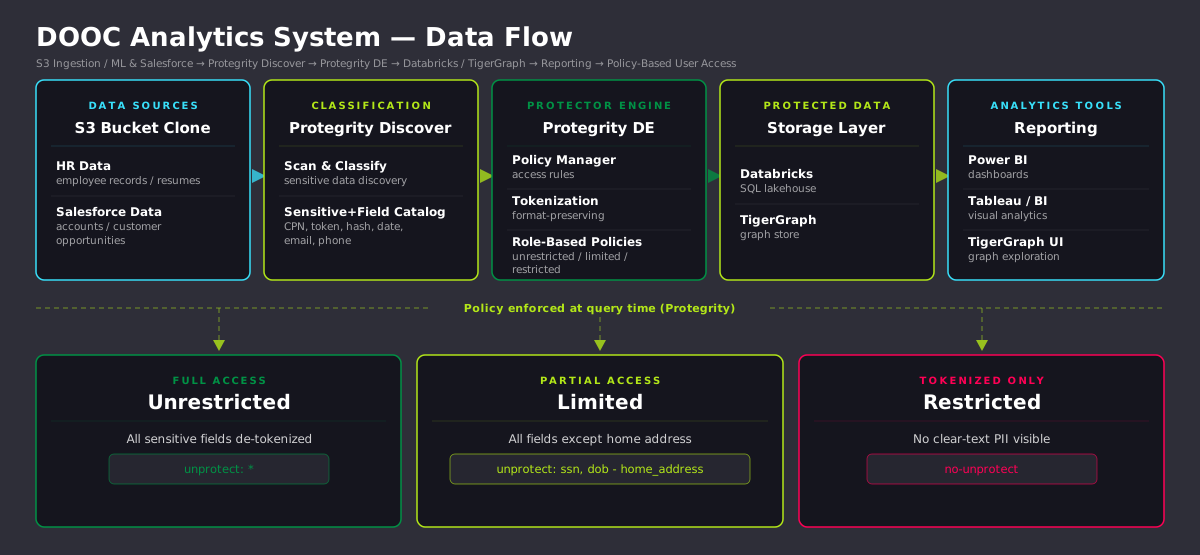
So, despite our company being smaller than our customers, I can still use the most advanced data and AI components, like Databricks, or PyDough (Bodo.ai), Qwen, all using the Protegrity product line, just like our customers. So, in other words, find your DooC, and you can “Have.” No grave here.
Is Your Company Building Independence, Not Dependence? (and the Rule of Seven Layers)
Dependence starts with the factory of inferencing. It’s not just GPUs, which run the math; it’s the high-bandwidth memory, the packaging that connects them, the networking that moves the data across the cluster, the power that keeps the racks alive, the cooling that holds the right temperature (sometimes requiring the more expensive direct-to-chip liquid cooling), and operations talent that keeps the whole thing running properly.1 So, imagine the frontier of AI intelligence resembling that of a steel mill rather than a software company, with an outrageous electric bill.
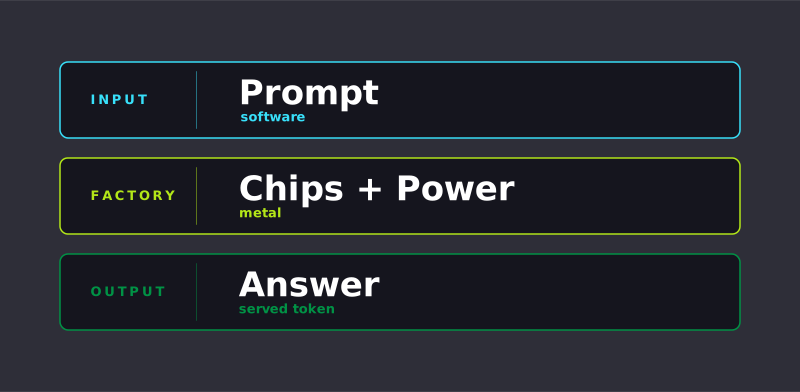
“Intelligence at Scale” requires a physical BOM, not just software. The models we use are manifestations of hyper costs. Amazon, for example, landed more than 2.1 million AI chips in the last 12 months, half of which were their own Trainium silicon, allocating $200B on data centers2. Anthropic just raised $65B on a $965B post-money valuation, and if you look closer, you see such names as Samsung, SK Hynix, and Micron on the cap table3. Within 18 months, every frontier lab will have hardware suppliers on its cap table, as well. The line between “supplier” and “customer” is becoming a balance-sheet annotation, not a market boundary.4 Basically, the industry now feels like a family reunion where everyone is quietly checking each other’s net worth. So very healthy.
What does this mean?
- Each of the big AI guys is hoarding AI BOM to compete against each other, and to compete against your independence.
- Stop looking at AI as software and start looking at AI as a physical manufacturing process, and therefore understand the realities of the units of economics
- Anthropic, OpenAI, and others don’t have a real business model, at least not yet, when reviewing the numbers from the Financial Times.5 This business model problem means they must suck you in, offer everything imaginable, like AGI, get you hooked, and, like a Trojan Horse, change their fees to support their insatiable requirement for data centers, ultimately making them the “haves” and you the “have-nots.”
Every time you pay them for a token, they own you more. As Thomas Kurian said, “If you don’t own chips and models, you are just a distributor.” He’s right.
Why is this important when you are trying to make an existential decision about your legacy company? Because legacy companies follow, they don’t lead. Leading means putting yourself on a path that makes you smarter, nimbler, and ready for the swings of the AI era. If that’s not enough, Anthropic and OpenAI are nerfing6 their older models, trying to persuade you to go to their new models, like a drug dealer with a new drug, keeping you hooked. All the while knowing that newer models are not necessarily better, or perhaps, more precisely, needed.7
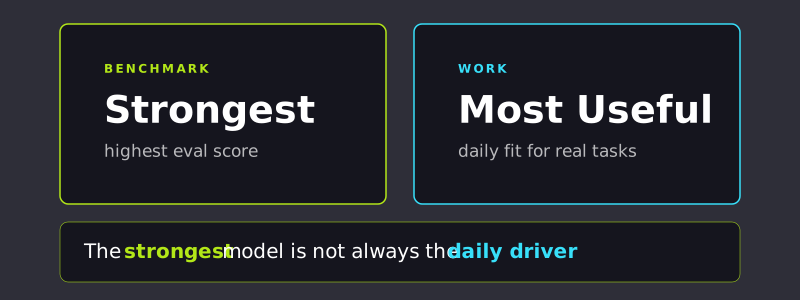
Thus, you must build your own Efficiency Stack. Lay out your own cluster (or compute), be it on your floor, on Bedrock, or on Together. Use open weight/SLMs, which are more efficient and can run on standard hardware. Use knowledge distillation, which shrinks massive AI models into smaller, lightweight versions (using a “teacher,” “student” model), akin to your own model. We used this technique at Protegrity for policy management, and it was very successful for us. But be careful, a customer may need 6-12 months to vet it before adopting. There are numerous other ideas like caching, batching, quantization, speculative decoding, and routing, all of which make your company an independent thinker and therefore a leader in the AI world.
But technical independence is not all of it. You must also be a subject matter expert; an expert in a leading-edge topic whose aggregate formulation cannot be simply derived from a model (a combination of genuine IP or a unique POV). As a CEO, we all know The Rule of Forty, which states that a company’s annual revenue growth rate and its profit margin should add up to 40%. I’ve never reached it, and if you have, you are the better person. The Rule of Forty for running a business is a wonderful goal, but we must now invent a different rule. I propose this new rule to be The Rule of Seven Layers.
To bake a seven-layer cake isn’t for the average baker; structural integrity and the cake-to-filling ratio take down even professionals. (I burn toast…) When I weigh whether an idea can survive a multi-hour vibe run across several pages of prompts (a PRD), I get worried, so I follow a disciplined approach to give us a fighting chance. The Rule of Forty has two axes, growth and margin. To compete now, I believe you must have seven.

These seven are variable: auditability, reliability, consistency, supportability, performance, or some special feature, or deep knowledge only a handful of people hold, like writing a performant homomorphic algorithm to train a model in the quantum space. The Rule of Seven is the layering of your distinction.
So, build your Efficiency Stack (Independence), and pass The Rule of Seven Layers, and you’re a “Have.” No need to dig an AI grave.
Engage in AI Fluency, with Objectives, Not Milestones
Every mission must have a mindset.8 Yours and your people. For me, a mindset has layers. Those layers, like nodes in a graph, are built about many things, like curiosity, words, methods, and, of course, the very nature of the mission. In this case, the nature of the mission is the decision to fight, and if you’re going to fight, you must know how to fight. And knowing how means having a plan. Don’t mistake motion for a plan because moving without one is a bigger risk than the risk itself. That plan is built from objectives, not milestones. A milestone is “we shipped a chatbot.” An objective is “everyone in this company can reason about AI, and its costs, its failure modes, its language.” Milestones get celebrated and forgotten. Objectives change who your people are.
Let me explain what I mean by words and their importance in a mindset. The words that people use are very important because words literally affect people psychologically and physically; you, me, boards, and customers alike.
In the book Thinking, Fast and Slow, Daniel Kahneman describes an experiment called The Florida Effect. (No, not the results of searching “Florida Man,” although feel free for a good laugh) In this experiment, participants were asked to arrange words into sentences. One group was given random words, while the other group was given words associated with old age, such as “Florida, lonely, careful, town, knitted, wrinkled,” and they were asked to form sentences with these words. After both groups finished, each participant was asked to walk down a hallway to fill out a final form. Kahneman’s researchers timed their walk down the hallway, and guess what happened… Those who had the “old” words walked more slowly than the participants who had the neutral words. The Florida Effect demonstrated that words affect us in all sorts of ways, which makes them very powerful and an important attribute of the mindset in a mission.
Now imagine that effect not in a hallway, but in a boardroom. The words you choose don’t just describe reality; they shape how customers perceive risk, trust, and ultimately, whether they think you are a real AI company, and buy your product or not. Everyone in the company must be trained on AI and speak the language. To do this, at Protegrity, we instituted a master class for AI. This wasn’t for everyone at the company, just a smaller group we call the “AI Tiger Team” (Sounds like a good one-hour drama to me). Train the trainer, so to speak. Here are some topics that we covered across four days:
- Deploy a production-grade LLM on GPU infrastructure
- Experiment with parameters that control AI behavior (temperature, top-k, top-p, prompts, quantization)
- Observe hallucinations and non-deterministic behavior firsthand
- Understand why LLMs cannot be trusted without grounding
- How embeddings represent meaning (and where they fall short)
- RAG pipeline (vector DB, semantic search, LLM integration)
- Create RAG with a knowledge graph and web search
- Eliminate hallucinations by grounding responses in verified data
Such a class helps across the company, for the website, agents, presentation material, and board presentations. It’s all good and important. At the same time, as CEO, don’t allow your people to outsource their ideas to AI. As much as you want your people to speak AI, you will also need to ensure LLMs are not doing all the work of ideation, elucidation, and PRD creation. If I see any email or PRD that is generated by an LLM, I throw them out. Yes, there is a tension here: I want my people fluent in AI and unwilling to let it think for them. That tension is the point. AI is the instrument; your people are the authors. Reverse that, and you have outsourced the one thing a model cannot replicate, your point of view.
Finally, you must free yourself from the past, whether it be revenue from some legacy product or overhangs of cultural inertia. It’s what’s in the front windshield, not the rear-view mirror.
So, to have and have not? It comes down to three questions and one verdict. If your own people use your product, with AI inside it, every day, you have a genuine capability. If you own your Efficiency Stack and can layer seven distinctions that no model can derive, you have independence. If your people speak the language of AI and still author their own ideas, you have fluency. Answer all three in the affirmative, and you’re a “Have.” Welcome aboard the gravy train. You are not in the grave.

Harry Morgan chose to fight, but he didn’t embark before he knew the waters. I hope my three questions help you navigate the waters ahead.
Also, Harry did eventually whistle.
mh
Sources and references
- Concept from Nat Jones video: https://m.youtube.com/watch?v=Poyi6X7rOwY&ra=m
- Amazon CEO Andy Jassy AI spending coverage: CNBC
- Anthropic valuation coverage: Yahoo Finance
- Anthropic Series H announcement: Anthropic
- The impossible maths of the AI boom (May 10, 2026), summarized by Thierry Borgeat on LinkedIn.
- VentureBeat coverage on Anthropic model performance reports: VentureBeat
- Nate’s Newsletter: https://natesnewsletter.substack.com
- Avery Blank, “5 Ways To Develop A Mission-Based Mindset And Let Go Of Your Ego”: Forbes