Is This Our End? Or Just Another Extinction Event?
Knowledge workers wiped out. Architectural legends unemployed.
Block announces ~40% RIF. Citrini AI report paints a dystopian future by 2028.
Your company is like the Titanic. Your career is over. Better to sell the house while people have money to buy it.
Stocks get battered, just so the winners win more. Trump wars in Iran, to distract, and WIN huge, regardless of outcome.
Spend five minutes on social media, and the conclusion seems obvious: we’re doomed.
My apologies. I just woke up. Let me make some pour-over coffee and meet you over at the kitchen table.
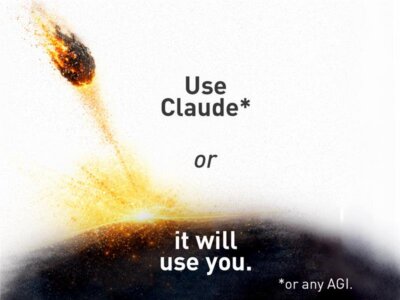
Thanks for waiting… With everything occurring in the world right now, I try to protect my mental state. The dinosaur in me says I’ve seen this movie before. Not once, but six times, economically speaking:
- 1980-1981 recession, triggered by the energy crisis
- 1990-1991 Gulf War and banking credit crunch
- 1997-1998 Asian financial crisis and Russian debt default
- 2001-2002 Dot-com Bubble, compounded by 9/11
- 2007-2009 Great Recession instigated by the US subprime mortgage crisis
- 2020 Covid
I do realize it’s somewhat ironic to use “the dinosaur in me.” For one, they’re extinct; for another, they were fierce, lasted a long time, and were only brought down by a massive asteroid, causing a “nuclear winter” that blocked sunlight, halted photosynthesis, and led to mass starvation. But man, they were some tough motherf*ckers. Am I right?
This fierceness, this need to survive, incentivizes itself and poses another way to review historical wipe-outs. Entire ecosystems disappear when the environment changes fast enough. Technology industries are no different. If you zoom out, the software industry itself looks like a graveyard of architectures, a continuous cycle of wipe-outs:
- 1970-1980s IBM mainframes dominate and become displaced by….
- 1990-1995 Client Server, which was quickly superseded by…
- 1995-2000 Distributed Systems (Unix) that get wiped out by…
- 2000-2005 Virtualization & Open Source put to rest by…
- 2005 – 2024 Hyperscalers
Dead bodies all over the place.
At Oracle, where I worked back in the day, I came up with a phrase: “Conspicuous Innovation.” It was a form of shock and awe, aimed as much at competitors and Wall Street as it was at customers. A way of signaling technological wealth and prestige through visible product velocity. For example, Oracle’s newest release, 26i, has almost 300 new features. That’s nearly one new feature developed for every working day of the year. Add Claude to that mixture, say at 1000x, and what do you have? I’ll leave you to decide.
I think I’ve had enough coffee.
So now that my central nervous system is online and cortisol levels are under control, allow me to observe our current artificial intelligence moment from a slightly higher perch. Closer to the sun…
Back in those earlier extinction cycles, you could still rely on the overall health of the software industry for hope. There was always the possibility that the next ingenious idea would change everything. You could put 25 of the best database people in a room, and you would never know what the result would be, whether the result would even work or not. That unknown future, which, in and of itself, caused value, just because it was hard. I think those days may be over.
The history of technology looks less like progress and more like paleontology. Dominant species confidently roam the earth for decades, feeling invincible, until an asteroid arrives and rewrites the ecosystem overnight. AGI might be that asteroid, and this isn’t theoretical. Here’s how this asteroid is already showing up in conversations with my engineers:
AGI Engineer: I built a core replacement of Snowflake in less than two days, and I think we should broaden our minds and compete with it.
Me: Are you crazy? No.
AGI Engineer [next day]: I can build a replacement for Salesforce in less than a week for the company, instead of paying SFDC. Save money.
Me: I hate SFDC. The answer still is no.
AGI Engineer [week later]: So, I used Claude 3.6 and now have a functional Agent registry and policy enforcement gateway. It enforces layers of policy for agents, people, or people delegating agents. It uses trust and attestation evidence as part of the attributes determined by the policies. Currently, I have interfaces for MCP Server, Python Client, Interactive Chat, SQLite, and Postgres. The same policies are enforced across all. It’s not a GA product… but it’s clean code, it has tons of integration testing built in … and I am kinda stunned.
Me: Great! Make it a product. And instead of replacing SFDC or building Snowflake, please completely replace our CICD pipeline, so I can use all the stuff you’re building using Claude.
Here’s where things get interesting.
To be honest, when I look at PRDs generated by Claude… they suck. I’ve returned every one of them to my product management team. If PRDs are going to be the driving force for Claude-generated code, the code will suck. If existing paradigms engineer products, you will simply get existing paradigms. If you worked at Oracle or Protegrity for twenty years, Claude will mostly confirm what you already believe is correct. If you’re building an index server and Claude suggests you might want a B-tree or a Bloom filter… wow… really?
Which leads to a deeper realization.
Leapfrogging is still more to me an organic artistic process, with layers of pattern matching, judgement making, soothsaying, right or wrong, late or too early. Which convinces me that our end doesn’t mean the end of us, it means our end of the equation: What we want to own and take on.
Because every extinction event allows one group to stand, and they’re the ones who evolve into the new ecosystem. Yes, the asteroid may already be in the sky, but the question is, really, whether it hits. And, if it does end up hitting us, what species will you become afterward?
My answer: Own your layer, and you’ll remain standing.
And if Claude can help me redo my kitchen along the way, I’m not complaining.
mh