Zero Trust Data Protection & Privacy with Protegrity and Databricks
I see the same fundamental challenge repeatedly when speaking with enterprise data teams: organizations want to move faster with advanced analytics and AI applications and agents, but their underlying security models were built for an older, more predictable data landscape. Data no longer stays neatly confined to relational rows and columns. Today, it moves across structured Delta tables, unstructured files such as PDFs, and real-time conversational AI prompts.
In many modern environments, relying on separate encryption tools, ad hoc masking rules, and isolated access controls creates significant operational complexity while increasing the risk of accidental exposure. That is why I find the joint architecture from Protegrity and Databricks on Microsoft Azure so compelling. It unifies data protection within a single, centralized model that spans structured data, unstructured content, and live AI workflows. By combining open data governance with centralized policy enforcement, organizations can securely accelerate AI innovation while maintaining control over sensitive enterprise data.
Why Traditional Data Security Fails Across Structured, Unstructured, and AI Data
As enterprise data moves across cloud ecosystems, security and platform teams usually face three distinct, interconnected problems:
- Fragmented Protection Policies: Enforcing uniform governance across structured tables, unstructured PDF files in Cloud and on-premise Storage, and dynamic AI models is incredibly difficult without central coordination.
- The Unstructured Data Black Hole: Sensitive information—such as name, credit card number, physical addresses or emails—is frequently buried inside complex documents like billing invoices. Manually finding, scanning, and masking this information is an error-prone process that stalls development.
- Static Access Controls: Modern enterprise applications demand dynamic, context-aware access. Relying on rigid, all-or-nothing file or table-level restrictions fails to meet the needs of modern applications that require fine-grained, Attribute-Based Access Control (ABAC).
Without a unified framework, organizations end up trapped in a counterproductive cycle: they either over-restrict data and cripple business analytics, or they over-expose sensitive data and expose the enterprise to significant compliance risks.
How Zero Trust Data Protection & Privacy Works with Protegrity and Databricks
What I find most effective about this specific approach is that it moves data protection and compliance logic directly into the Databricks platform layer itself, rather than leaving it siloed inside individual downstream applications.
As illustrated in the architectural overview, combining Protegrity’s pseudonymization with the native governance capabilities of Databricks Unity Catalog allows the architecture to protect data automatically at rest and reveal it dynamically at runtime only when explicit policies allow it.
Automated Discovery and Pseudonymization for Unstructured PDFs
The lifecycle begins at the storage layer within Azure Data Lake Storage Gen2 (ADLS):
- Ingestion: Raw, clear-text PDFs containing sensitive customer data arrive in an isolated input directory.
- Discovery & Protection: An automated process scans these documents, utilizes Protegrity to discover specific sensitive elements and applies pseudonymization.
- Secure Output: The system creates new, protected versions of these PDFs in an output directory, where sensitive fields are replaced by secure values, and tags are appended to mark the content as protected by default.
Unity Catalog Integration and ABAC Governance
Once the data is secured at rest, Unity Catalog serves as the centralized engine for access management:
- Unified Volumes: Unity Catalog establishes secure volumes that link directly to the protected PDFs, allowing downstream tools to access them safely.
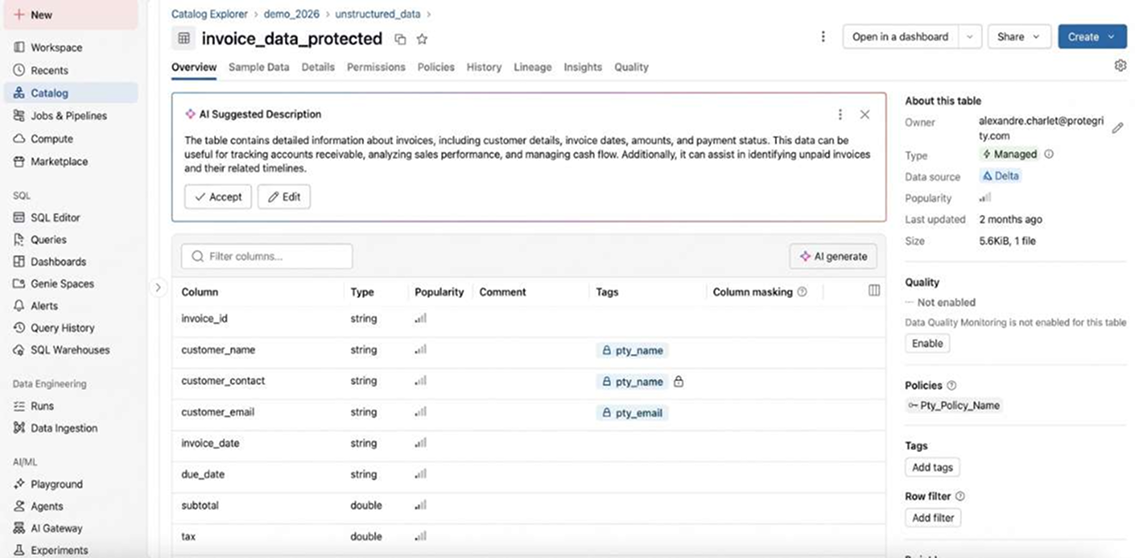
- Tag-Based Policies: Table fields and file paths are flagged with specific governance tags directly inside Unity Catalog.
- Embedded Protegrity UDFs: Protegrity User-Defined Functions (UDFs) are integrated directly into Unity Catalog policies. This ensures that any runtime query or data fetch automatically evaluates the user’s role and attributes before executing on-the-fly unprotection. This unified governance model enables organizations to apply consistent security policies across structured and unstructured data while providing the trusted foundation needed for enterprise AI workloads.
Zero Trust in Action: Enterprise Use Cases Examples
To see the operational value of this architecture, we can look at how the exact same underlying security policy behaves dynamically across different application interfaces.
Use Case A: The Standalone PDF Viewer
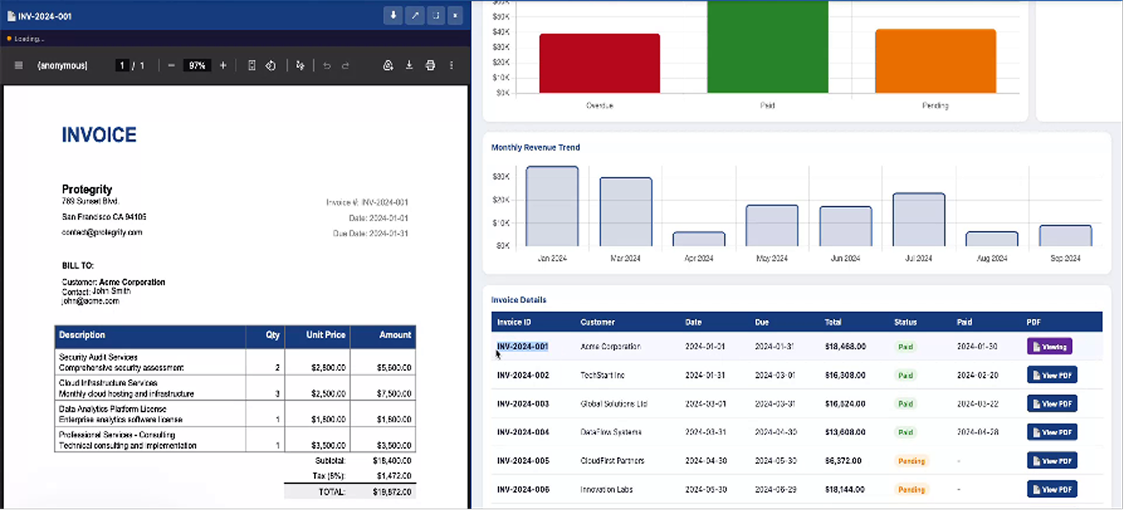
When an employee opens a customer invoice through a dedicated PDF Viewer application, the app leverages the embedded Protegrity UDFs inside Unity Catalog to evaluate their credentials in real time:
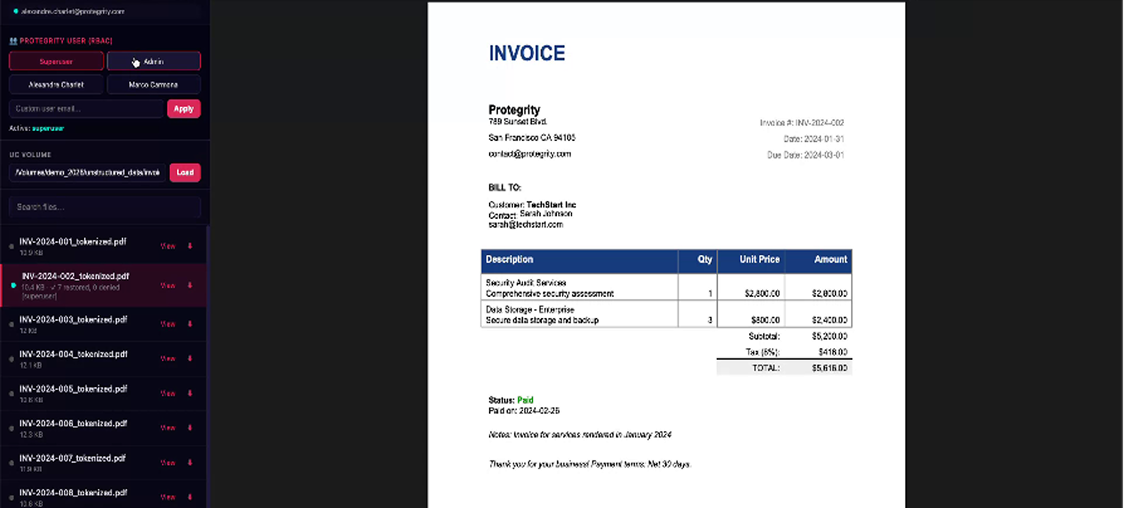
- The “Super User” Role: An authorized billing manager opens a document. The system verifies their clearance and decrypts the tokenized fields on the fly, rendering the address and email in clear text.
- The Platform Admin Role: A system administrator opens the exact same file. Because their role involves system maintenance rather than customer service, the policy restricts clear-text access. They see only the default tokenized values, maintaining a strict separation of duties.
- Operational Impact: This dual-path viewer ensures that sensitive documents remain universally protected at rest, eliminating the need to save duplicate, masked versions of files for different business teams.
Use Case B: The Invoice Dashboard
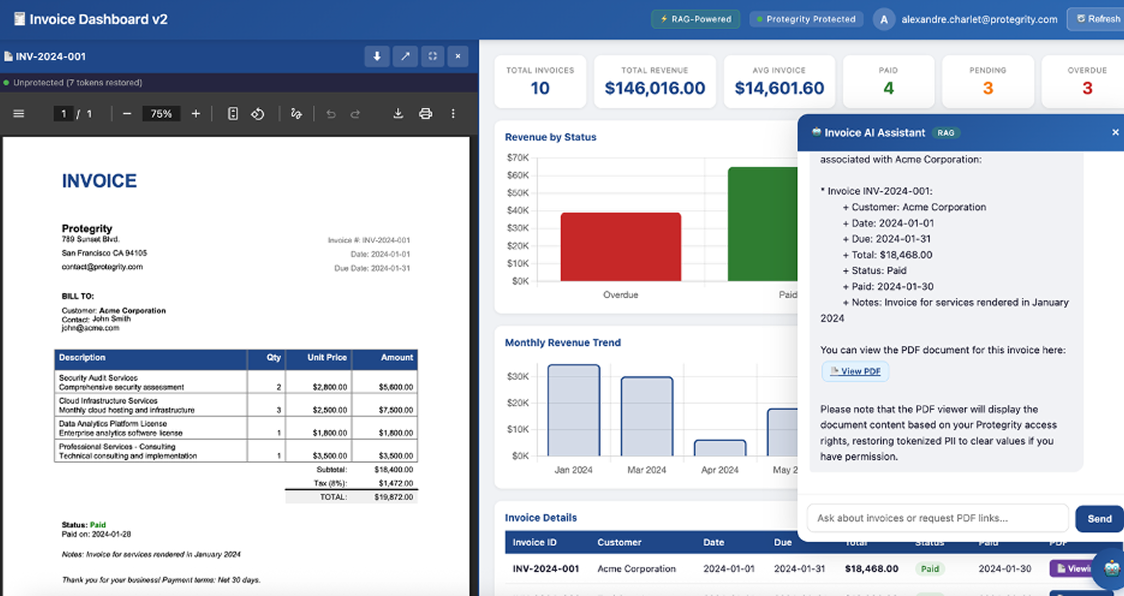
Enterprise dashboards typically require a balance of high-level analytics and detailed row-level inspection. This architecture addresses both needs seamlessly within a singular view:
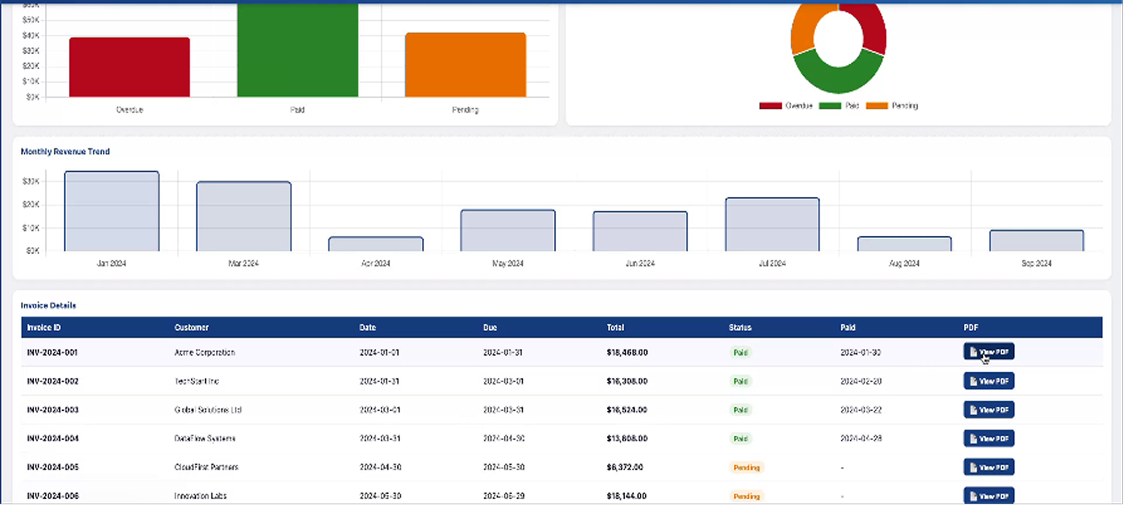
- Aggregated Analytics: Financial users can interact with high-level monthly metrics or payment trends over structured tables without exposing underlying PII.
- Granular Drill-Downs: If an authorized billing analyst needs to inspect a specific invoice row, the dashboard applies on-the-fly deprotection to individual fields, such as revealing the specific client name securely for that user session.
- Operational Impact: By keeping analytical data masked at rest, organizations can democratize BI dashboard access widely while restricting clear-text fields to an absolute need-to-know basis.
Use Case C: The Secure Conversational AI Chatbot
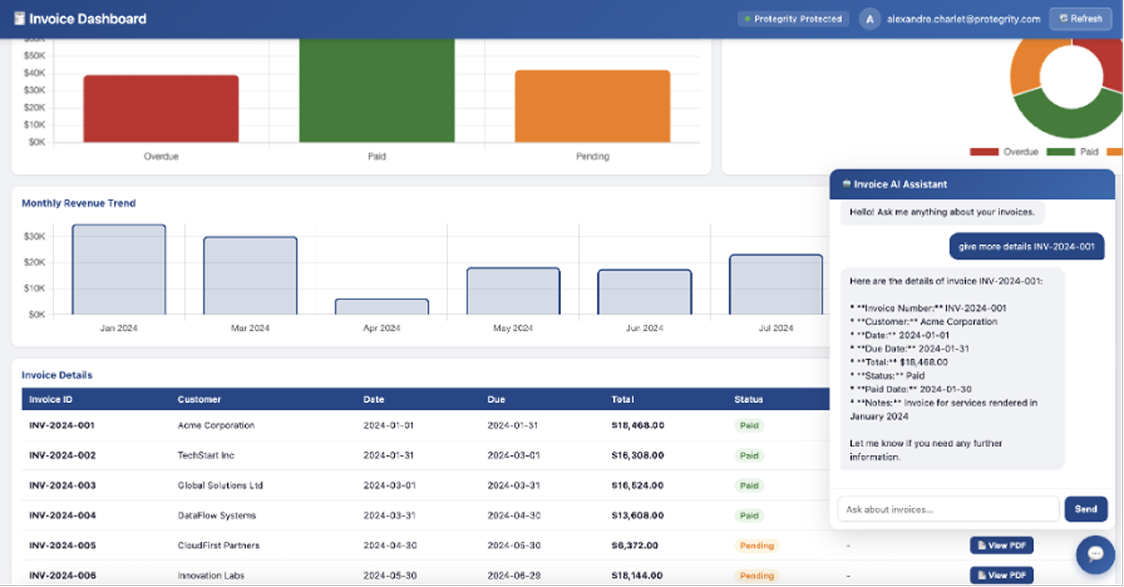
Integrating AI applications and agents into enterprise workflows introduces significant data leakage risks. In this architecture, when an employee interacts with an internal chatbot or assistant (such as Databricks Genie), the conversational flow is tied directly to the same underlying governance rules:
- Prompt and Flow Protection: If a user submits a query regarding customer invoices, the chatbot uses Unity Catalog’s tags and Databricks policies to govern its response behavior
- Just-In-Time Deprotection: The chatbot applies on-the-fly deprotection to the generated response only if the user’s role permits it. If an unauthorized user asks a question, the sensitive variables remain tokenized or hidden within the assistant’s output.
- Operational Impact: This approach allows organizations to safely deploy AI applications and agents and internal virtual assistants across complex corporate datasets without the risk of AI models exposing sensitive PII to unprivileged users.
Business Benefits of Centralized Data Protection & Privacy in Databricks
By moving security out of individual application silos and embedding it directly into the Databricks platform, this architecture simplifies compliance for every persona across the organization:
- Data Protection and Security Officers gain a single framework to confidently enforce compliance and maintain a strict separation of duties across tables, PDFs, and AI tools alike.
- Platform and Databricks Administrators drastically reduce operational friction. They can configure tags and policies once and reuse the exact same protection logic across CSP and on-premise storage volumes, dashboards, and AI workflows without duplicating code.
- Application Owners and Business Users can innovate faster, utilizing aggregated dashboards and secure conversational assistants with the peace of mind that sensitive data is protected by default and only relaxed when explicitly authorized. This approach helps organizations accelerate the development of trusted AI applications and agents while maintaining centralized governance over enterprise data.
Why Zero Trust Data Protection & Privacy Matters for Enterprise AI
Achieving a true “Zero Trust” posture does not mean locking your data away from your teams; it means making your data smart enough to protect itself. By integrating Protegrity’s robust pseudonymization engine directly with Databricks Unity Catalog, organizations can dismantle historical data silos. This unified approach secures every layer of the cloud data ecosystem, allowing businesses to innovate rapidly with analytics and AI while keeping compliance and data security completely uncompromised.
Check out the Protegrity & Databricks Integration